The Birth of Capitalism: From Its Emergence to the Twentieth Century; Struggle and Paradigms
Categories
History of Philosophy, Political PhilosophyTags
Philosophy of Law, SociologySummary
This article examines capitalism as a historical, economic, and intellectual system, tracing its emergence from the collapse of feudalism to the twentieth century while analyzing its commercial and industrial phases, ideological foundations, and the reactions it provoked, particularly socialism and critiques of imperialism.
Extended Summary
This article investigates the historical emergence and development of capitalism from the late Middle Ages to the twentieth century, focusing on its intellectual, economic, and social foundations. Capitalism is not approached merely as an economic mechanism but as a comprehensive social structure shaped by political power, class relations, ideology, and historical conditions. Understanding capitalism requires examining the paradigms that enabled its rise as well as the struggles that emerged in reaction to it.
The dissolution of the feudal system in Europe constitutes the historical background of capitalism. Feudalism was characterized by land-based production, rigid social hierarchies, and the domination of feudal lords over serfs. As trade expanded and monetary relations intensified, a new social class—the bourgeoisie—began to challenge the feudal order. This class derived its power not from land ownership but from commerce, capital accumulation, and control over emerging markets.
Intellectual developments played a decisive role in this transformation. The Renaissance, Reformation, and Enlightenment undermined scholastic thought and religious authority, placing reason, individualism, and empirical inquiry at the center of human activity. These movements weakened the ideological foundations of feudalism and legitimized new economic practices based on private property, free enterprise, and rational calculation.
The earliest phase of capitalism may be described as commercial capitalism. This form emerged between the decline of feudalism and the Industrial Revolution and was closely linked to long-distance trade, colonial expansion, and mercantilist economic policies. European powers sought precious metals, controlled trade routes, and accumulated wealth through colonial exploitation. Mercantilism promoted state intervention, protectionism, and the export of manufactured goods, facilitating the initial concentration of capital in private hands.
The bourgeoisie played a central role throughout this period. Initially, it supported monarchical authority against feudal lords to secure stability and trade privileges. Later, it opposed absolute monarchy in favor of liberal and republican ideas when political authority began to threaten its economic interests. This strategic flexibility allowed the bourgeois class to shape political structures in accordance with capitalist needs.
The Industrial Revolution marked the transition from commercial to industrial capitalism. Mechanization, technological innovation, and the use of steam power transformed production processes and increased output dramatically. Agriculture lost its dominant position as societies shifted toward industrial economies. Large numbers of rural workers migrated to cities, forming an industrial working class that sold its labor for wages.
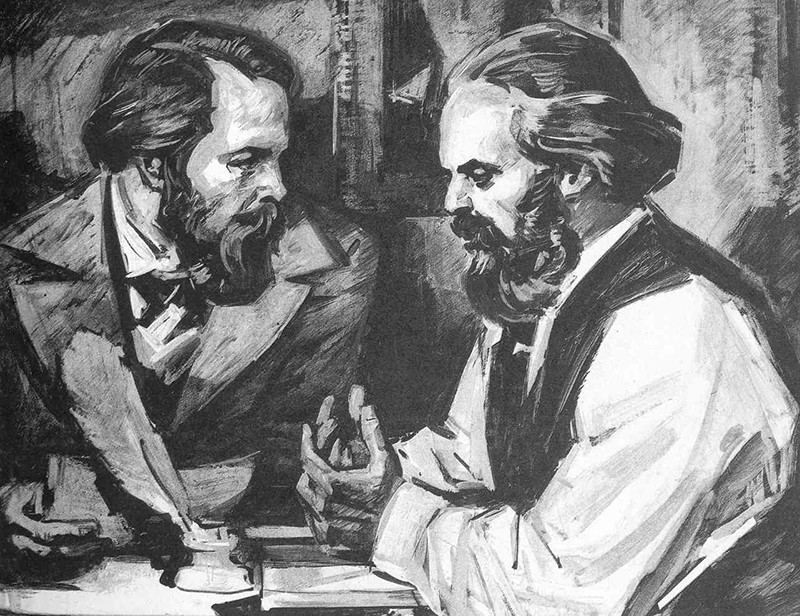
Industrial capitalism intensified class divisions. Capital and labor became structurally separated, with ownership of the means of production concentrated in the hands of capitalists. Thinkers such as Karl Marx analyzed this system critically, arguing that capitalism alienates workers from their labor, their products, and their own human potential. Marx’s theory of surplus value explained how profit is generated through the exploitation of labor, providing a powerful critique of capitalist production.
Different intellectual interpretations sought to explain the origins of capitalism. Max Weber emphasized the role of Protestant ethics, particularly Calvinism, in encouraging rational labor, capital accumulation, and disciplined lifestyles. Fernand Braudel approached capitalism as a long-term historical structure operating above and beyond market economies, while Marx situated it within class struggle and historical materialism. These perspectives reveal that capitalism cannot be reduced to a single cause or dimension.
As industrial capitalism expanded, imperialism emerged as a strategy to resolve economic crises caused by overproduction and declining profit rates. Capitalist states exported capital and goods, colonized foreign regions, and integrated global markets into their economic systems. While imperialism was often justified as a civilizing mission, its primary function was to secure resources, markets, and profits for capitalist centers.
Reactions to capitalism developed alongside its expansion. Socialism emerged as a response to class exploitation and social inequality, initially advocating workers’ rights and later proposing alternative social and economic orders. Although socialism and communism aimed to overcome capitalist contradictions, their historical implementations revealed new forms of domination and inequality.
In conclusion, capitalism is a dynamic and adaptive system that has transformed European and global societies profoundly. It has contributed to technological progress and economic growth while simultaneously generating inequality, imperialism, and social conflict. From its emergence out of feudalism to its dominance in the twentieth century, capitalism has been shaped by intellectual paradigms, political struggles, and class relations. Understanding this complex history is essential for critically engaging with contemporary economic and social realities.
Note: You can access the full article via the links below.
Download Article Read on Academia