What is Idelogy?
Categories
Philosophy, Axiology, Philosophy of Human Nature, Political PhilosophyTags
Metaphysics, Philosophy of Mind, Sociology, Value Philosophy, Moral Philosophy, Reason and Critical Thinking, ConceptsSummary
This article analyzes ideology as a systematic method oriented toward specific goals, exploring its historical meaning, defining criteria, relationship with belief, and the possibility of personal and non-political ideologies in contemporary thought.
Extended Summary
This article examines the concept of ideology, a term whose meaning has become increasingly ambiguous in contemporary discourse. Ideology is often reduced to a purely political label or even used as a pejorative expression. However, such uses obscure the conceptual depth of ideology and prevent a proper understanding of what it actually represents. The purpose of this article is to clarify what ideology is, how its meaning has evolved, and how it should be understood today.
Etymologically, the term ideology is formed from the word idea and the suffix -logy. The concept of “idea” contains two fundamental meanings: first, an idea as a possible plan or course of action; second, a purpose or goal toward which this plan is directed. When these meanings are considered together, an idea is not merely a thought but a structured orientation toward action. In this sense, an idea functions as a plan, method, or roadmap designed to achieve a particular goal.
When combined with the suffix “-logy,” ideology refers to a systematic discipline concerned with ideas that guide action toward specific ends. Ideology is therefore not a random collection of beliefs but a structured method pursued in accordance with particular values and goals. It provides both direction and justification for action, whether individual or collective.
The term ideology was first systematically used in the late eighteenth century by the French philosopher Antoine Destutt de Tracy, who described it as a “scientific discipline of knowledge.” For Tracy, ideology was the systematic study of ideas in the human mind. He emphasized that ideologies must be examined methodically, rather than treated as arbitrary or purely subjective beliefs. In this sense, ideology was seen as a tool for understanding both individual thought and collective worldviews.
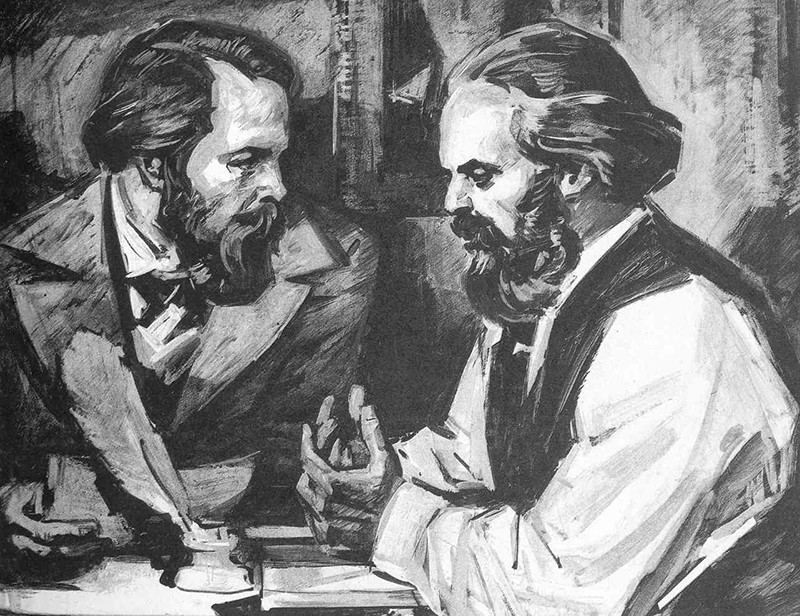
The meaning of ideology underwent a significant transformation with Karl Marx and Friedrich Engels. They redefined ideology as a set of ideas that serve particular class interests while masking real social relations. In their analysis, ideology became a central element of class struggle and a mechanism for legitimizing existing power structures. As a result, ideology acquired a strongly political and critical dimension that continues to influence how the term is perceived today.
In contemporary usage, ideology is often employed to describe political, social, or cultural systems of belief. However, this usage has also contributed to a negative connotation. Expressions such as “you are being ideological” frequently imply rigidity, bias, or irrationality. This perception reduces ideology to something undesirable, rather than recognizing it as an inevitable component of human thought and social organization.
To understand ideology more clearly, it is necessary to identify its defining criteria. For something to qualify as an ideology, it must first pursue a goal. This goal may involve social change, political organization, cultural transformation, or personal ideals. Second, ideology must contain systematic methods for achieving that goal. A disorganized collection of ideas does not constitute an ideology. Third, an ideology must be grounded in values or beliefs that legitimize its objectives and methods.
Ideology should also be evaluated on two levels: ideology itself and the individual’s relationship to ideology. A person may adhere to a single ideology or adopt multiple ideological positions across different domains of life. For example, an individual may hold religious beliefs while simultaneously supporting a particular economic or political ideology. In such cases, individuals construct what can be described as their own ideological package.
This raises the question of whether a personalized ideology is possible. The answer is affirmative. An individual’s thoughts and beliefs can form a unique ideology, provided they are systematized and oriented toward coherent goals. A mere collection of unstructured opinions does not constitute an ideology. Once these ideas are organized into a consistent framework, they become a personal ideology, even if no one else shares it.
Another common misconception is that ideology must necessarily involve political practice. While many ideologies are political, ideology as such is not limited to the political sphere. Ideologies may be cultural, religious, philosophical, or related to lifestyle choices. Movements such as minimalism or aestheticism, for example, function as ideologies despite lacking explicit political objectives.
The relationship between ideology and belief is also frequently misunderstood. Some argue that ideologies lack belief in order to distinguish them from religions. However, ideologies are almost always grounded in beliefs and values. These beliefs shape ideological goals and provide motivation for adherence. In some cases, ideologies may even assume quasi-religious characteristics, particularly when leaders or doctrines are treated as unquestionable.
In conclusion, ideology is a complex and multifaceted concept that cannot be reduced to political dogma or dismissed as mere bias. It represents a systematic orientation toward goals, grounded in values and beliefs, and expressed through structured methods. Ideology operates not only at the level of societies and states but also within individual identities and lifestyles. Recognizing this complexity allows for a more accurate and nuanced understanding of ideology in the modern world.
Note: You can access the full article via the links below.
Download Article Read on Academia